Quote by Edward Catlin Art Is Not What You See but What You Want Other to See
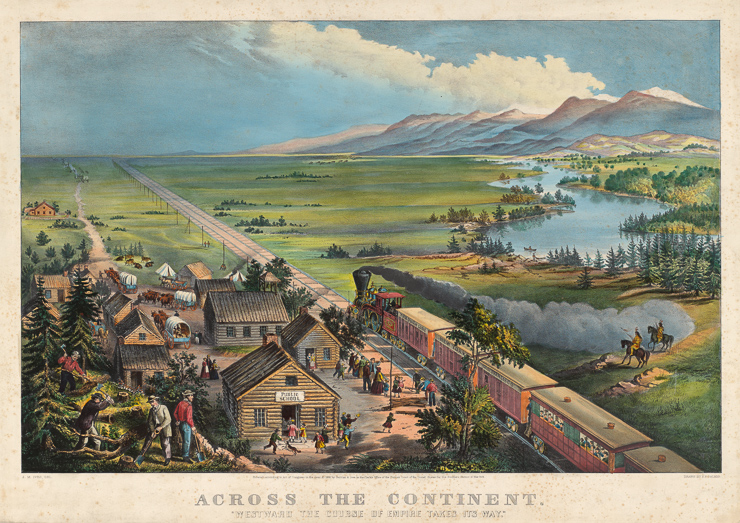
Fanny Palmer created this print for Currier and Ives, a printmaking arrangement that sold millions of cheap colored prints in the 19th century. Palmer's print reinforces the ideology of manifest destiny—the belief that Us expansion westward was destined and justified—using a variety of details and symbols:
· The depiction of the railroad anticipates the 1869 completion of the Transcontinental Railroad, emphasizing technological progress and connectivity.
· The subtitle, "Westward the Grade of Empire Takes Its Way," directly quotes the championship of an 1861 mural by Emanuel Leutze located in the U.s. Capitol that also tells a triumphant story about w migration.
· Expansive, empty lands seem available for the taking, even though hundreds of Native tribes lived in these areas.
· Smiling families, tidy buildings, and a prominent school and church make settlement look attractive and civilized, although in reality it was arduous for settlers and threatened the lives of indigenous peoples.
· Americans Indians—unremarkably feared and perceived as a hindrance to due west expansion in the 19th century—are cut off from settlement by the train tracks and left behind in the train's exhaust.
Palmer, a British immigrant, would likely take never traveled to the western United States. Today, scholars debate whether prints like this i informed and shaped viewers' thoughts and values, or whether they reflected what consumers already believed.
How is the story depicted here similar to or unlike from the story you've learned about westward migration?
ane of 21

This portrait of White Cloud is role of a grand projection creative person George Catlin undertook beginning in 1830 subsequently working as an attorney and lithographer. Catlin decided to document and draw indigenous peoples that were quickly disappearing in the United States in the 1830s and 1840s due to violence and disease. Ultimately, Catlin visited numerous tribes and created hundreds of paintings.
Catlin and his works take been both praised and criticized. He has been praised for the following reasons:
· His portraits show individuals, not just romanticized stereotypes.
· Portraits, including the portrait of White Deject seen here, present alternative cultural representations of wealth and leadership, in the same vein as portraits of George Washington and other U.s.a. figureheads.
· He showed sympathy with and involvement in American Indians—even defending them publicly—at a fourth dimension when many European Americans, as well equally the US government, denigrated and feared indigenous peoples.
· Some of his works draw people, practices, and events that otherwise are not visually documented.
All the same, looking through a 21st-century lens, Catlin'south work may be challenging:
· He saw himself equally a savior, even superior to his subjects: "I accept flown to their rescue—not of their lives or of their race (for they are 'doomed' and must perish), merely to the rescue of their looks and their modes."
· Neither his works nor his written accounts of his travels around the U.s. are strictly factual depictions, even though his work is often seen as ethnographic.
Mew-hu-she-kaw, known both as White Cloud and No Eye-of-Fear, was one of several tribal chiefs of the Iowa people in the mid-19th century. Catlin painted his portrait while the main was in London trying to raise money for the Iowas, who had been forced to a pocket-size reservation in southeast Nebraska. What do you retrieve and feel about this portrait now? What questions would you inquire White Cloud if given the opportunity?
To learn more most White Deject and the Iowa people, explore this NGA lesson plan.
2 of 21
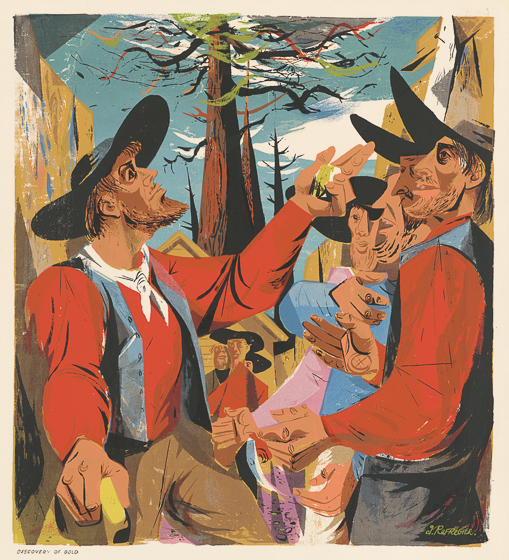
This impress is adapted from ane of 27 murals titled The History of California that artist Anton Refregier completed for the Rincon Annex Post Office between 1940 and 1948. Refregier depicted the moment in January 1848 when James W. Marshall discovered gold at Sutter's Mill in northern California.
While gold had been discovered earlier in the area, the publicity of this discovery prompted 300,000 people to "blitz" to California in search of gold and wealth. "Forty-niners" faced treacherous weather as they traveled across the western U.s., while others endured long body of water trips from Latin America, Europe, Pacific islands, and Red china. The discovery of gold brought wealth to some, only many others experienced discrimination, loss, or even death, including thousands of Native peoples who were murdered by forty-niners and Usa war machine members.
Wait closely. What emotions practise you think the men in Refregier's print are feeling? What practise y'all remember aureate symbolized for them? What do you think gilded might have symbolized to Native peoples in the surface area? Notation that Refregier likely depicted at least one Chinese man, second from right. According to the Library of Congress, "No starting time-person memoirs of the Chinese experience in nineteenth-century California are known to survive."
For a deeper dive into other get-go-person narratives from the California gold rush, see the Library of Congress'due south collection "California as I Saw Information technology".
Anton Refregier,Discovery of Gold, 1949, screenprint, Reba and Dave Williams Collection, Souvenir of Reba and Dave Williams, 2008.115.4064
three of 21

The "Mexican News" referenced hither was that the US–Mexican State of war was coming to an terminate in 1848, later on two years of fighting. Richard Caton Woodville completed the original painting in 1848, and artist Alfred Jones engraved a copy for distribution to members of the American Art-Union.
This may look similar a scene from everyday life, but Woodville filled the work with symbols and metaphors:
· The "American Hotel" is meant to correspond the whole country.
· The worn wooden porch and the dual-purpose hotel/mail service function represent the frontier.
· The porch holds voting citizens, white males, whose faces suggest a diverseness of opinions about the war.
· Those outside the porch stand up in for all disenfranchised African Americans and women, who had no voting rights.
Nearly people in the United states would have been keenly interested in the effect of the war. A win meant newly acquired territory (more than than 500,000 acres) and a debate over the add-on of slave or free states.
Ask your students to take on the point of view of a character shown in this work. What practise you think their thoughts or feelings might be nigh the news, given their body language and facial expressions? What might this news mean for them at this moment in fourth dimension? Who might take been affected by this news but excluded from the image?
Consider how y'all receive news today. How does it touch on you, and how might information technology affect others similarly or differently?
Alfred Jones, Richard Caton Woodville, American Art-Spousal relationship,Mexican News, 1851, engraving in black on wove paper, Corcoran Drove (Souvenir of Donald Webster), 2015.19.1049
four of 21
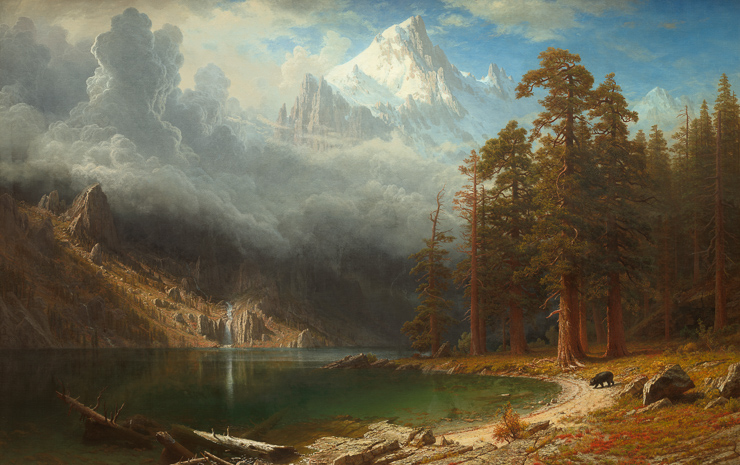
The original title of this painting was Mountain Lake. Albert Bierstadt renamed the painting Mount Corcoran subsequently collector William Wilson Corcoran to persuade the wealthy businessman to purchase the painting and identify information technology in his museum (which he ultimately did).
Bierstadt actually named a mount after Corcoran, but information technology does not look like the thousand peak in this painting. He, similar other landscape painters before him, sometimes combined details fatigued from real life to create imaginary scenes. Albert Bierstadt followed in a long line of US mural painters who suggested that American history and destiny could be found in its geography. Bierstadt's massively scaled paintings—showing craggy mountains, tall lakes, and stunning vistas—confirmed that the US possessed majestic natural resources comparable to those plant in Europe.
As the US government caused territory to the west, residents back east became curious: What do these new lands look similar? How can I get in that location? Might I be able to brand a new life there? Bierstadt—who joined expeditions to survey newly acquired territories—made his last paintings back east and traveled with them from town to town, where residents paid a pocket-size fee to get a glimpse of them.
What can we learn about the Westward from Bierstadt's works? Why might it affair that Bierstadt's paintings were fictionalized? If yous had never seen a movie of the western Us before, exercise you lot retrieve these paintings might have convinced you lot to movement there?
Albert Bierstadt,Mount Corcoran, c. 1876–1877, oil on sheet, Corcoran Collection (Museum Purchase, Gallery Fund), 2014.79.4
5 of 21

Green River, Wyoming, was a bustling railroad town when Thomas Moran arrived in 1871. 3 years earlier, Union Pacific construction crews had arrived intent on bridging the river. Their tent army camp rapidly became a boomtown boasting a schoolhouse, hotel, and brewery. Yet none of these structures appear in Moran's Green River paintings. Even the railroad is missing. Instead, the dazzling colors of the sculpted cliffs and an equally colorful band of American Indians are the focus. In a bravura display of artistic license, Moran erased the reality of advancing settlement, conjuring instead an imagined scene of a preindustrial West that neither he nor anyone else could have seen in 1871.
Compare Moran's painting to what Green River would have looked similar around the time when he arrived.
How do you experience about Moran'south painting afterwards looking at the photograph? Why do you retrieve he included groups of American Indians on horseback? Does it thing if the painting is true or non? In what ways might this painting connect to electric current events today?
Thomas Moran,Green River Cliffs, Wyoming, 1881, oil on canvas, Gift of the Milligan and Thomson Families, 2011.ii.i
6 of 21

The Us buffalo (or bison) population had been reduced from millions in the early 19th century to about ane,000 when Albert Bierstadt created this painting in the 1880s. Multiple forces coincided to impale off the bison:
· Plains Indians had go increasingly dependent upon the bison; hunting the animals was easier after the Spanish brought the horse to the continent in the 16th century.
· Market demand in the U.s.a. and Europe for bison hides increased dramatically in the 1870s.
· Modern rifles and newly completed railroads across the West fabricated it like shooting fish in a barrel and economical to kill animals and transport hides.
· The US military machine realized that eliminating the buffalo meant the elimination of Plains Indians: "I wanted no other occupation in life than to ward off the roughshod and kill off his food until in that location should no longer be an Indian frontier in our beautiful land," said Lieutenant-Full general John M. Schofield, head of the Department of the Missouri from 1869 to 1870.
Bierstadt's painting, while reflecting the reality of the loss of the bison, is as well romanticized and imagined. He made this vista and harks dorsum to a time when the Plains Indians were the only predators of the buffalo.
This was Bierstadt's final slap-up Western painting, and he created it at a time when interest in such paintings was waning. Why practise you remember he might have called to depict the loss of the buffalo in this way? What emotions do you have looking at this painting? How might this painting connect to global issues today?
Albert Bierstadt,The Last of the Buffalo, 1888, oil on canvas, Corcoran Collection (Gift of Mary Stewart Bierstadt [Mrs. Albert Bierstadt]), 2014.79.5
seven of 21
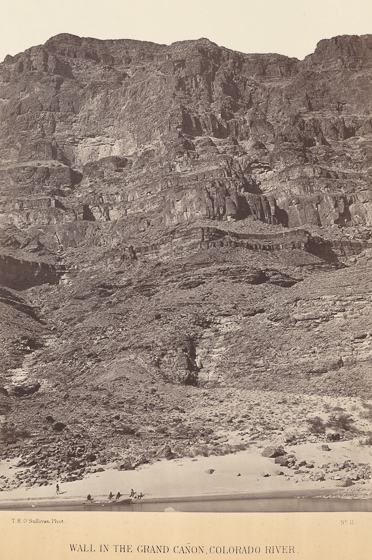
The US W is marked by stunning geologic features and a vast landscape that dwarfs humans. Early photographers to the West set out to capture a sense of this for Easterners.
Timothy H. O'Sullivan and William H. Bell, both immigrants and Civil War veterans, each served as photographers for the Wheeler Survey, which set out to first explore, so map, The states land due west of the 100th meridian.
Compare this delineation with William H. Bell's delineation of the 1000 Canyon. How are they similar? How are they different? Which photo gives viewers a better sense of the scale of the West? Compare these photographs with paintings by Albert Bierstadt and Thomas Moran. Practise you think these photographs or the paintings would take been more persuasive to potential settlers?
viii of 21
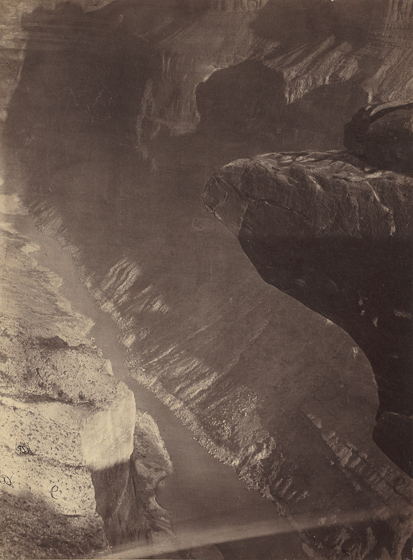
The US West is marked by stunning geologic features and a vast mural that dwarfs humans. Early on photographers to the West set out to capture a sense of this for Easterners.
Timothy H. O'Sullivan and William H. Bell, both immigrants and Civil War veterans, each served every bit photographers for the Wheeler Survey, which set out to first explore, then map, U.s. country w of the 100th meridian.
Compare this depiction with Timothy H. O'Sullivan'south delineation of the Grand Canyon. How are they similar? How are they unlike? Which photo gives viewers a better sense of the scale of the West? Compare these photographs with paintings by Albert Bierstadt and Thomas Moran. Do you think these photographs or the paintings would have been more persuasive to potential settlers?
9 of 21
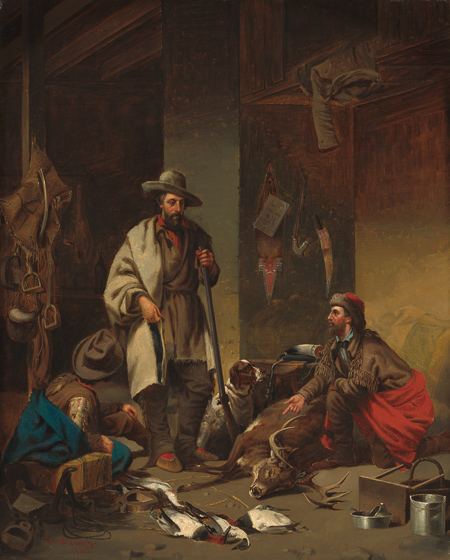
This painting was probably intended to exist an homage to fur trappers as well as a political commentary.
Trappers, especially those who lived and worked in the West, assumed national hero status in the 1850s and 1860s. Their rugged lifestyles and perilous adventures, romanticized in novels and images, came to symbolize burgeoning United states of america character and exceptionalism. John Mix Stanley, who tended to focus his creative efforts on indigenous portraits, capitalized on this interest past depicting white trappers in this highly detailed scene. The fur trade drove European interest in the continent for centuries. By the 1820s, US trappers had fabricated their manner to the Rocky Mountains, though the fur trade died by the 1840s due to lagging need.
This painting went by the championship The Disputed Shot for many decades. It may accept been intended to show trappers modeling civil dialogue at a time when disagreements over slavery were mounting. While at that place'due south no proof Stanley met Dred Scott, the infamous Dred Scott case was decided past the US Supreme Court in 1857, the year earlier Stanley painted this scene.
If Stanley intended this picture to model ceremonious dialogue, what roles do each of the men shown play? What exercise you think the effect of the discussion might be? Where do you meet civil dialogue happening today?
John Mix Stanley,The Trapper's Cabin, 1858, oil on sail, Corcoran Collection (Gift of William Wilson Corcoran), 2014.79.44
10 of 21
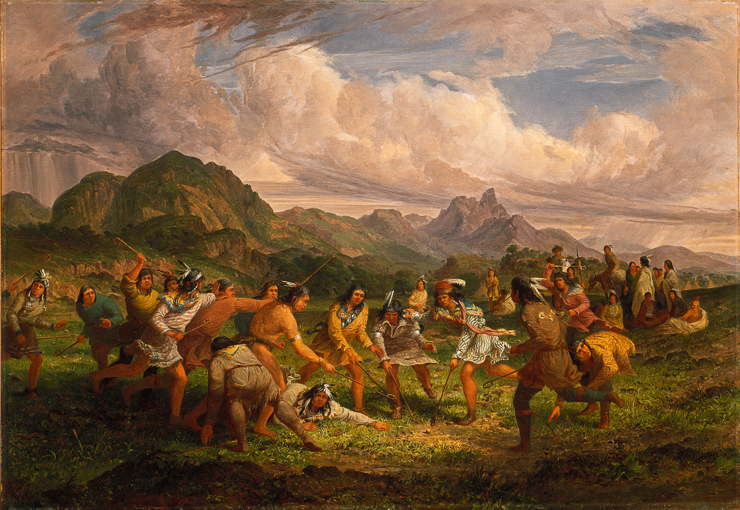
Does this game look familiar? How would you describe the contest?
Seth Eastman depicted a grouping of Santee (Eastern Dakota) playing a game that was a forerunner to lacrosse. Stakes were high—games could final for days, and winners received both prizes and food.
Eastman, an artist and Usa Army officer, was stationed twice at Fort Snelling (in present-twenty-four hours Minnesota), which was located virtually where the Santee lived. During his first tour, which began in 1830, Eastman became fluent in Santee and married Wak inajin win, the 15-yr-former daughter of Main Maḣpiya Wic̣aṡṭa (Deject Man). Eastman left behind his wife and new baby when he was reassigned after three years. He returned to Fort Snelling for a 2d bout as post commander from 1841 to 1848. He brought a new wife with him, and together they embarked upon studying the Santee, after publishing their writing and illustrations in a book.
Fort Snelling was constructed after the decision of the War of 1812 to protect Us fur merchandise interests and build relationships with indigenous peoples, including the Santee and Anishinaabe (Ojibwe). It was congenital on a site of strategic and cultural importance, where the Minnesota and Mississippi Rivers come across. To the Santee, this was a sacred area known as B'dote, the "heart of the earth." The confluence served every bit a critical fur trading juncture throughout the 19th century.
Fort Snelling later became an internment camp where more than 1,700 Santee women, children, and elders experienced disease and decease after the US–Dakota War of 1862.
11 of 21
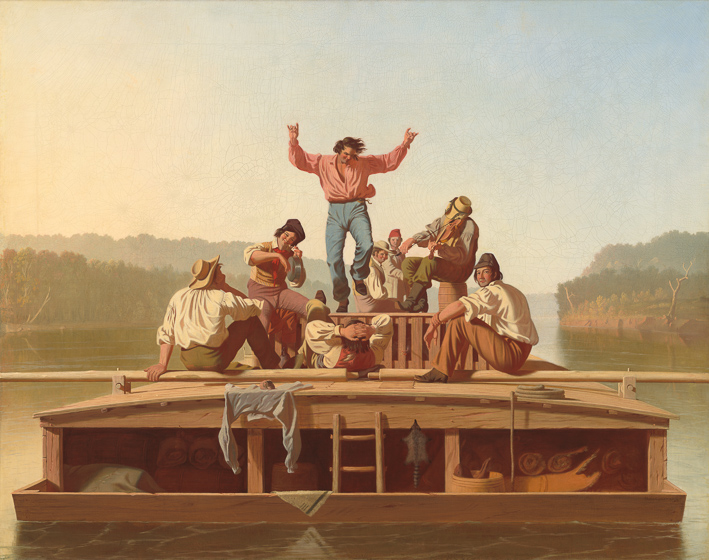
Music, dancing, relaxing—these men are enjoying themselves as they navigate a flatboat downwards what is likely the Missouri River, the longest river in North America.
In the early 1800s, goods and people moved via a network of waterways beyond the state. Flatboats were rectangular vessels designed to bear large loads of cargo. George Caleb Bingham, a self-taught artist, lived near the Missouri River and depicted the civilization of trappers and boaters in his paintings. Flatboats were ordinarily used past farmers, and later, professional person boaters, but by the start of the Civil War, steamboats and railroads had largely displaced flatboat employ.
Abraham Lincoln navigated a flatboat twice downward the Mississippi River to New Orleans, first every bit a 19-twelvemonth-erstwhile in 1828, and again in 1831. Scholars have argued that these trips to the Deep Southward shaped his behavior about slavery.
Looking at Bingham's painting, what do you imagine life was like for a flatboatman? What parts of the feel are not revealed hither? What challenges might flatboatmen have encountered, and what skills might they have needed to navigate the rivers?
George Caleb Bingham,The Jolly Flatboatmen, 1846, oil on canvas, Patrons' Permanent Fund, 2015.18.1
12 of 21
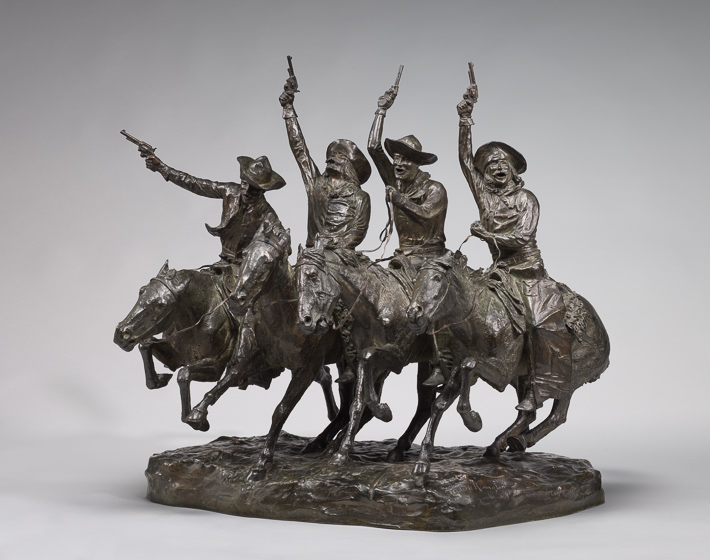
When you picture a cowboy in your head, what comes to heed?
This bronze sculpture reflects the popularity of cowboys at the turn of the century. Cowboys became national folk heroes in office because of Frederic Remington'south paintings, sculptures, illustrations, fiction, and nonfiction that idealized the Usa West, cowboys, and American Indians.
What was the life of a cowboy really similar? Who was a cowboy? The romanticized white male person cowboy may dominate visual media, but in the late 19th century ane-quarter of cowboys were black, and American Indians, Mexicans, Latinos, and women besides held those jobs.
13 of 21

What practice you call back of when you hear the word pioneer? In the U.s.a., the word is all the same strongly associated with the many European American settlers who fabricated their way west in the 19th century.
This object—described using the word pioneer—was painted by an artist hired by the US government during the Bully Low as function of a project chosen the Index of American Design. I of the goals of this project was to "tape material of historical significance which has not heretofore been studied and which, for one reason or another, stands in danger of being lost."
Examine this image. What can you learn from this object nigh "pioneer life"? Dive deeper into the topic by reading Andrea Warren's Pioneer Daughter: A True Story of Growing Up on the Prairie.
European American settlers claimed lands in the West from indigenous peoples who left their homelands or were forcibly relocated. How does this information touch on the manner you lot think about pioneers?
Verna Tallman,Pioneer Doll, c. 1937, watercolor, graphite, and gouache on paper, Index of American Design, 1943.8.15444
14 of 21

What do yous retrieve of when you hear the give-and-takepioneer? In the United States, the word is still strongly associated with the many European American settlers who made their way west in the 19th century.
This object—described using the give-and-take pioneer—was painted by an creative person hired by the US government during the Bully Low every bit function of a project called the Index of American Design. One of the goals of this project was to "record material of historical significance which has non heretofore been studied and which, for one reason or some other, stands in danger of beingness lost."
Examine this image. What can you learn from this object most "pioneer life"? Swoop deeper into the topic by reading Andrea Warren'southPioneer Girl: A Truthful Story of Growing Up on the Prairie.
European American settlers claimed lands in the West from indigenous peoples who left their homelands or were forcibly relocated. How does this data affect the manner y'all retrieve most pioneers?
Elbert Due south. Mowery,Pioneer Common salt Gourd, 1935/1942, watercolor, pen and ink, and graphite on paper, Alphabetize of American Blueprint, 1943.8.11364
xv of 21

What do y'all think of when you lot hear the discussionpioneer? In the Us, the word is still strongly associated with the many European American settlers who made their way due west in the 19th century.
This object—described using the word pioneer—was painted by an artist hired past the U.s. government during the Not bad Depression equally part of a project chosen the Index of American Design. 1 of the goals of this project was to "tape material of historical significance which has not heretofore been studied and which, for one reason or another, stands in danger of being lost."
Examine this image. What can y'all learn from this object most "pioneer life"? Dive deeper into the topic by reading Andrea Warren'due southPioneer Girl: A Truthful Story of Growing Up on the Prairie.
European American settlers claimed lands in the West from indigenous peoples who left their homelands or were forcibly relocated. How does this information affect the way y'all recollect about pioneers?
American 20th Century,Pioneer Bathroom Tub, 1935/1942, watercolor and graphite on paperboard, Index of American Design, 1943.viii.8644
16 of 21

William Henry Jackson and Carleton Watkins are oft recognized for their striking photographs of the natural mural of the United states West, but they also captured the region'due south rapid economic development.
Central City, Colorado, was founded in 1859 after gold was discovered nearby. Jackson's photograph shows a city already well adult subsequently just 20 years. Even Jackson himself had attempted to make a living as a miner in the past.
What story of the West does this image tell? What surprises you most this photograph?
William Henry Jackson,Central Metropolis, Colorado, c. 1881, albumen impress, Amon G. Carter Foundation Fund and Buffy and William Cafritz Fund, 2011.21.ane
17 of 21

William Henry Jackson and Carleton Watkins are ofttimes recognized for their striking photographs of the natural landscape of the US West, only they also captured the region's rapid economic development.
San Francisco experienced a massive population boom after golden was discovered in northern California. In less than two years the mining town'due south population increased from ane,000 to 25,000, including a large Chinese population. Fears that Chinese immigrants were driving declining wages and taking the jobs of native-born US residents led to the passage in 1882 of the Chinese Exclusion Deed, the outset major US law restricting immigration to the land. The law finer prohibited Chinese people from inbound the US and barred Chinese immigrants from becoming US citizens for decades.
What story of the West does this image tell? What surprises you about this photograph?
18 of 21
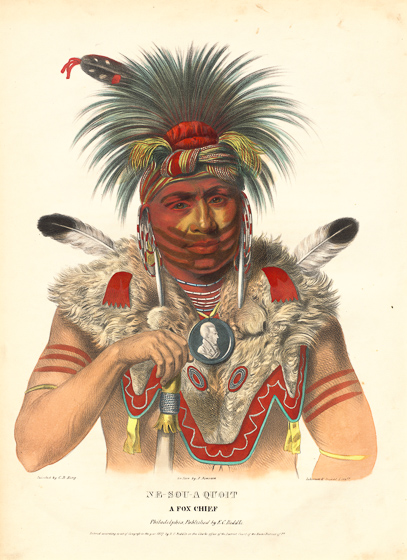
Look closely at this portrait of Ne-Sou-A Quoit, originally painted past Charles Bird King. How is the figure dressed? What expression can you lot notice on his face up? What does his body language communicate?
Between 1821 and 1842, King created a series of portraits of Indian dignitaries visiting Washington, DC, for Thomas McKenney, Superintendent of Indian Affairs. King's portraits were copied past lithographers, distributed for a fee, and bound in a book published by McKenney and James Hall titled History of the Indian Tribes of North America. McKenney was an advocate and supporter of Indian sovereignty. He installed artifacts and these paintings in the War Office Building next door to the White House, where Native and non-Native visitors akin could view the display.
While some scholars have argued that European American artists similar King romanticized or imposed a European vision upon their indigenous subjects, others accept argued for the bureau and autonomy of Native sitters. Ne-Sou-A Quoit is dressed in clothing that indicates he was a leader and potency of his people. All Native and non-Native diplomats were judged by their appearance and dress at this time. A Peace Medal depicting President Andrew Jackson hangs around Ne-Sou-A Quoit's neck. Although the presence of the medal may exist surprising to viewers today, the Meskwaki (Fox) chief may have worn information technology knowing information technology could contribute to more successful negotiations with the US government.
The Meskwaki, closely associated with the Sauk (Sac), ultimately signed a treaty in 1842 with the US ceding lands in Iowa, where they had moved from Wisconsin, and earlier that, Ontario.
Albert Newsam, Charles Bird King, Lehman & Duval Lithographers, Edward C. Biddle,Ne-Sou-A Quoit, a Flim-flam Chief, 1837, hand-colored lithograph on wove paper, Donald and Nancy de Laski Fund, 2014.168.1
xix of 21
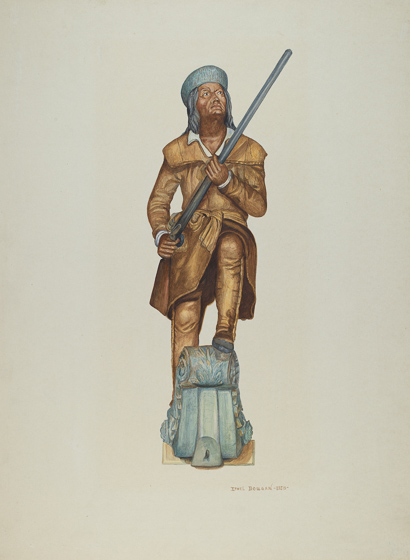
This figurehead of Davy Crockett adorned the front of a ship named after the 19th-century folk hero; the send was built in 1853 in Mystic, Connecticut.
Crockett grew upwardly in Tennessee and represented the land as a member of the US Congress. He opposed many Jacksonian policies, including the Indian Removal Act, and fought in the Texas Revolution, where he died.
The figurehead was selected for inclusion in the Index of American Design, a federally sponsored Depression-era projection that employed artists to document "material of historical significance."
Research more about Davy Crockett. Why did he become a national folk hero? To whom was he a hero?
Whom would you consider a contemporary folk hero?
Ethel Dougan,Figurehead: Davy Crockett, 1938, watercolor, graphite, and pen and ink on paperboard, Index of American Design, 1943.8.17407
20 of 21
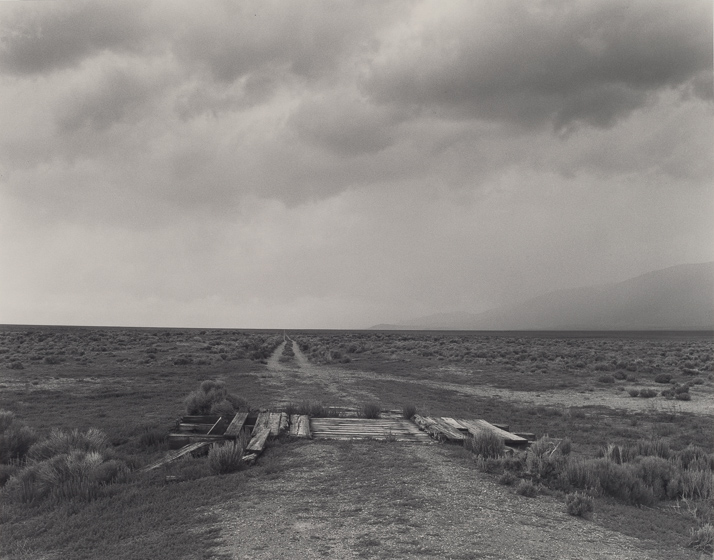
Look closely at this photograph. What do you lot think it shows? During which decade do you call up it might accept been taken?
It may surprise you to learn that the photograph was taken in the 1990s and shows the remnants of a railroad that fabricated travel to the US Due west possible. The Cardinal Pacific Railroad was part of the US Transcontinental Railroad. Structure began in Sacramento and moved east until it famously connected to the Union Pacific Railroad in Promontory, Utah.
Mark Ruwedel took photographs of the railway remnants in the Us and Canadian West for nearly twenty years. He titled the project "Westward the Course of Empire," alluding to 19th- and early on 20th-century expansionist ideologies while documenting the in one case-mighty railroad's decline.
How does this photograph brand you feel? Where tin can you find evidence of built environments or manufacture from the past in your community? What story exercise these remains tell?
Mark Ruwedel,Central Pacific #28, 1993–1994, gelatin silverish print, Gift of Dan and Jeanne Fauci, 2012.112.3
21 of 21
childresspriagenction.blogspot.com
Source: https://www.nga.gov/features/slideshows/manifest-destiny-west.html
0 Response to "Quote by Edward Catlin Art Is Not What You See but What You Want Other to See"
Post a Comment